Basic Optical Fiber Metrics
Scott Prahl
May 2024
[1]:
%config InlineBackend.figure_format='retina'

import sys
import scipy
import numpy as np
import matplotlib.pyplot as plt

if sys.platform == "emscripten":
    import micropip
    await micropip.install("ofiber")

import ofiber
The relative refractive index or Δ
Compare result with an approximation.
[2]:
n_clad = 1.48
n_core = 1.5
Δ_approx = (n_core - n_clad) / n_core
print("Δ = %.5f (approximation)" % Δ_approx)
Δ = ofiber.relative_refractive_index(n_core, n_clad)  # exact
print("Δ = %.5f" % Δ)
Δ = 0.01333 (approximation)
Δ = 0.01324
Numerical Aperture of a step index fiber
A convenience method to find the numerical aperture given the core and cladding index.
[4]:
n_clad = 1.48
n_core = 1.5
Δ = (n_core - n_clad) / n_core

NA = n_core * np.sqrt(2 * Δ)
print("NA    = %.4f (approximation)" % NA)
NA = ofiber.numerical_aperture(n_core, n_clad)
print("NA    = %.4f" % NA)
NA    = 0.2449 (approximation)
NA    = 0.2441
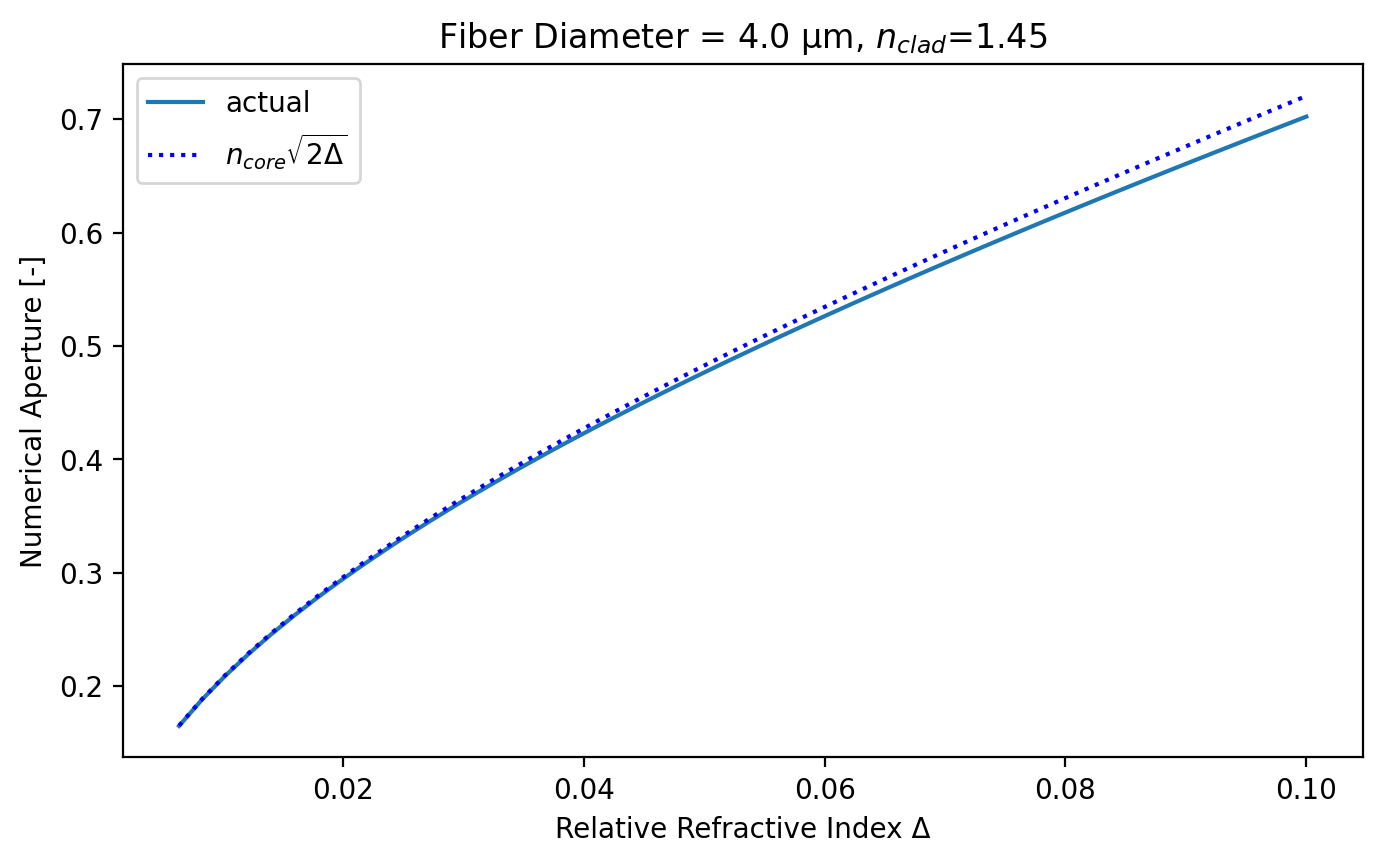
We can easily make plots. Here is the variation of the exact numerical aperture and that obtained with the approximation to \(\Δ\)
[5]:
r_core = 2e-6
n_clad = 1.45  # pure SiO2

Δ = np.linspace(0.0064, 0.1, 50)
n_core = n_clad / (1 - Δ)

NA = ofiber.numerical_aperture(n_core, n_clad)

plt.figure(figsize=(8, 4.5))
plt.plot(Δ, NA, label="actual")
plt.plot(Δ, n_core * np.sqrt(2 * Δ), ":b", label=r"$n_{core}\sqrt{2\Delta}$")
plt.xlabel(r"Relative Refractive Index Δ")
plt.ylabel("Numerical Aperture [-]")
plt.title(r"Fiber Diameter = %.1f µm, $n_{clad}$=%.2f" % (2 * r_core * 1e6, n_clad))

plt.legend()
plt.show()
The V-parameter for a fiber
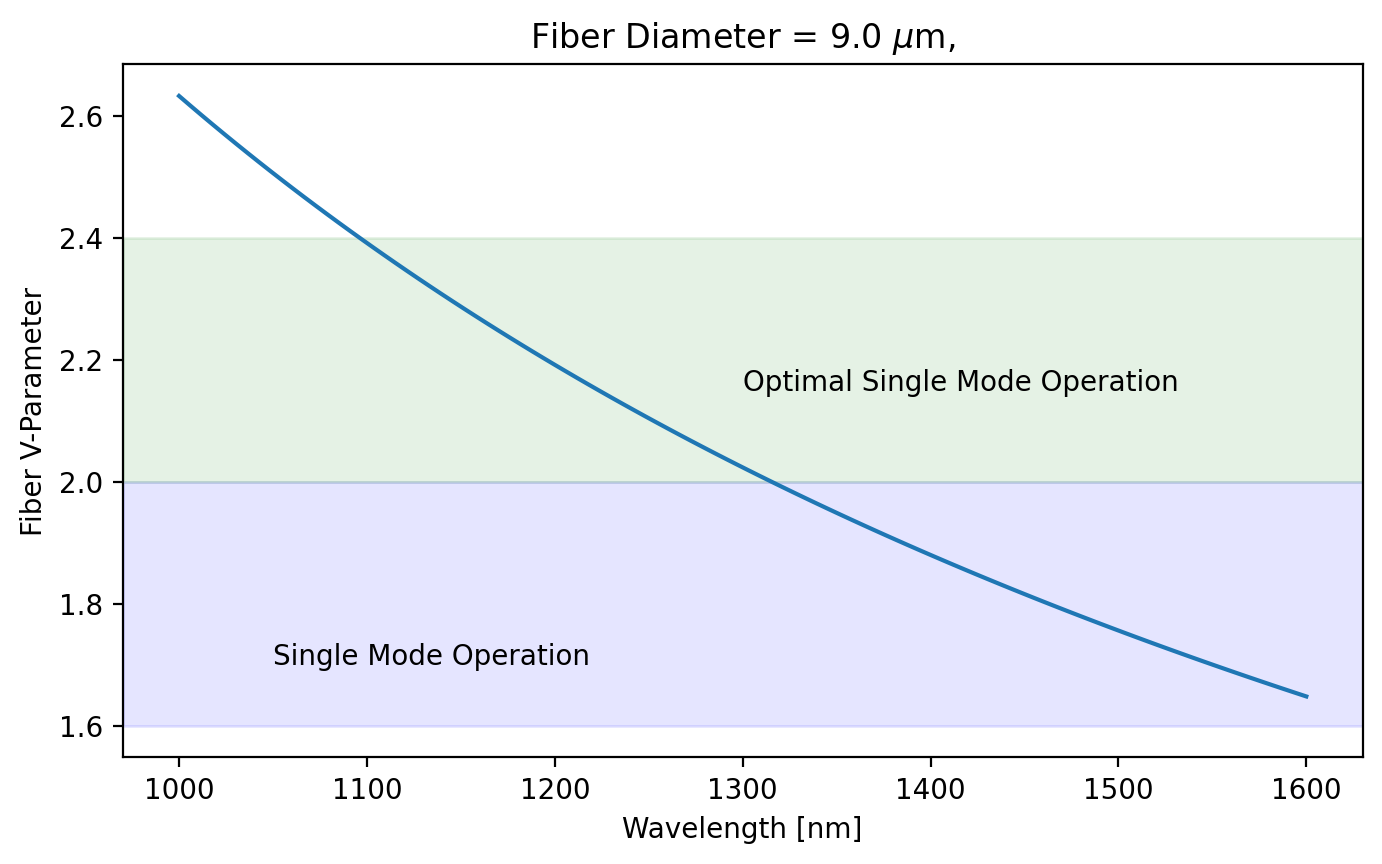
This helps characterize the number of modes in a fiber. If \(V\gg 2.4\) then the number of modes is
\[N \approx \frac{V^2}{2}\]
[6]:
d = 9e-6  # m
r_core = d / 2
λ = np.linspace(1000, 1600, 100) * 1e-9  # m

clad = ofiber.doped_glass(0)  # pure SiO2
n_clad = ofiber.n(clad, λ)

core = ofiber.doped_glass(0.02)  # 2% GeO2
n_core = ofiber.n(core, λ)

NA = ofiber.numerical_aperture(n_core, n_clad)
V = ofiber.V_parameter(r_core, NA, λ)

plt.figure(figsize=(8, 4.5))
plt.plot(λ * 1e9, V)
plt.axhspan(1.6, 2.0, color="blue", alpha=0.1)
plt.axhspan(2.0, 2.4, color="green", alpha=0.1)

plt.ylabel(r"Fiber V-Parameter")
plt.xlabel("Wavelength [nm]")
plt.title(r"Fiber Diameter = %.1f $\mu$m," % (d * 1e6))
plt.text(1300, 2.15, "Optimal Single Mode Operation")
plt.text(1050, 1.7, "Single Mode Operation")

plt.show()
The cutoff wavelength for a fiber
[7]:
r_core = 2e-6  # m
Δ = 0.0064
n_clad = 1.45
n_core = n_clad / (1 - Δ)
NA = n_core * np.sqrt(2 * Δ)
lambdac = ofiber.cutoff_wavelength(r_core, NA)

print("Cutoff wavelength is %.0f nm" % (lambdac * 1e9))
Cutoff wavelength is 863 nm
Example page 21 in Powers
The effect of a graded index fiber on the cutoff wavelength.
[8]:
d = 8e-6  # m
r_core = d / 2  # m
λ = 1300e-9  # m

n_core = 1.46
V = 2.1
NA = V / 2 / np.pi * λ / r_core

lambdac = ofiber.cutoff_wavelength(r_core, NA)
print("Cutoff wavelength is %.0f nm (step-index)" % (lambdac * 1e9))

lambdac = ofiber.cutoff_wavelength(r_core, NA, q=2)
print("Cutoff wavelength is %.0f nm (parabolic fiber)" % (lambdac * 1e9))
Cutoff wavelength is 1135 nm (step-index)
Cutoff wavelength is 803 nm (parabolic fiber)
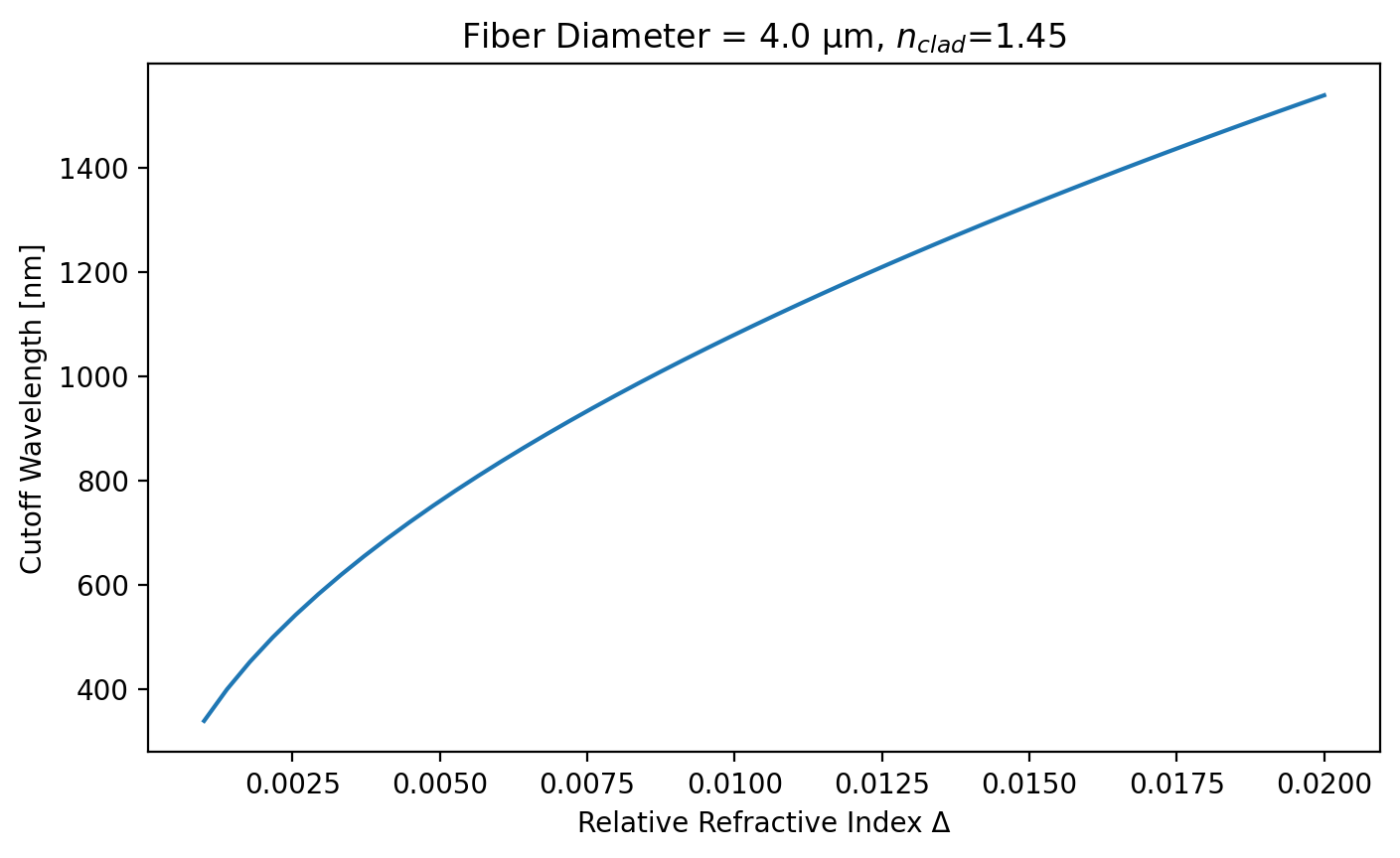
Finally, how does the cutoff wavelength depend on the relative refractive index?
[9]:
r_core = 2e-6
n_clad = 1.45
Δ = np.linspace(0.001, 0.02, 50)

n_core = n_clad / (1 - Δ)
NA = ofiber.numerical_aperture(n_core, n_clad)
lambdac = ofiber.cutoff_wavelength(r_core, NA)

plt.figure(figsize=(8, 4.5))
plt.plot(Δ, lambdac * 1e9)
plt.xlabel(r"Relative Refractive Index Δ")
plt.ylabel("Cutoff Wavelength [nm]")
plt.title(r"Fiber Diameter = %.1f µm, $n_{clad}$=%.2f" % (2 * r_core * 1e6, n_clad))
plt.show()